











Remembering the Events of September 2001
Plymouth, MN; September 11, 2026 – As the United States pauses today to remember the lives lost on September 1…

Built for how enterprise networks work today.
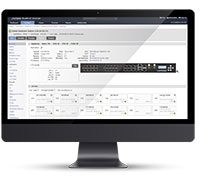
Lantronix Centralized Management Software

Federal IT leaders are facing a familiar squeeze: the demands on government networks are accelerating faster than budgets can keep up. Artificial intelligence, a growing swarm of connected devices, and evolving agency missions are all converging on infrastructure that, in many cases, was designed for a very different era of computing.
|
That was the starting point for a recent Lantronix webinar, Modernizing Mission-Critical Networks for the AI Era, led by Senior Product Manager GlenNiece Kutsch. With 25 years in telecommunications and networking infrastructure, Kutsch walked attendees through the forces reshaping federal networks, what a modern zero-trust architecture actually requires, and how agencies can get there without a costly, disruptive overhaul.
Three Forces Are Rewriting the RulesThe pressure on federal networks is based on three converging forces: |
|
| The scale of the challenge is real. Recent Google Public Sector research surveying 250 federal IT leaders found budget constraints (75%), security and adversarial risk (48%), and legacy systems (41%) as the top blockers to AI adoption. The takeaway from the webinar was blunt: modernizing the network isn’t optional. It’s a prerequisite for AI. | 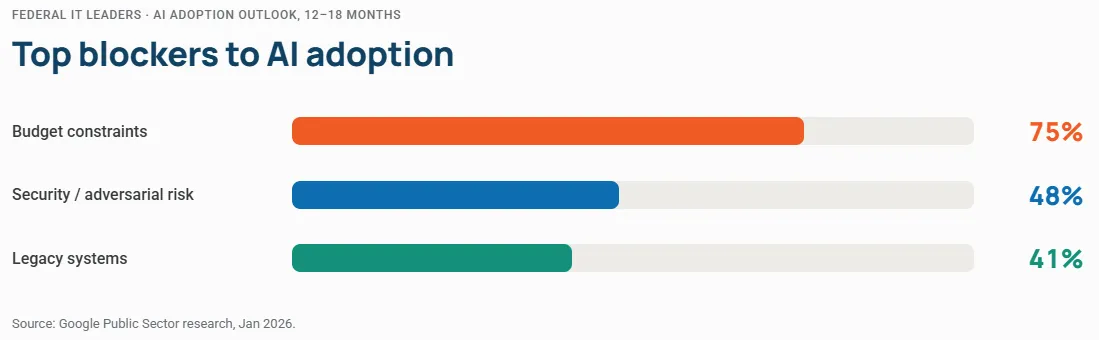 |
Most legacy federal networks are straining under four pressures: insufficient bandwidth and speed for more users, devices, and data; distance and signal-loss limitations of copper cabling as processing moves to the edge; heightened security requirements for transmitting sensitive information; and equipment lifecycles that can’t keep pace with how fast the underlying technology is evolving.
It helps to see this in the context of how far federal networks have already come. From ARPANET in 1969, to the DoD’s adoption of TCP/IP in 1983, to the public internet of the 1990s, federal networking has continually reinvented itself. Today’s requirement is a network built as a “digital fortress” — segmented, monitored, and grounded in Zero Trust principles.
A modern Zero Trust network today typically layers together seven capabilities: departmental networks (the routers and switches inside government facilities), a high-speed backbone connecting branches, clouds, and data centers, secure data centers, SD-WAN for intelligent path routing, monitored cloud connectivity, multi-level security zones that isolate classified from public systems, and AI-driven monitoring that can flag and block suspicious activity in real time.
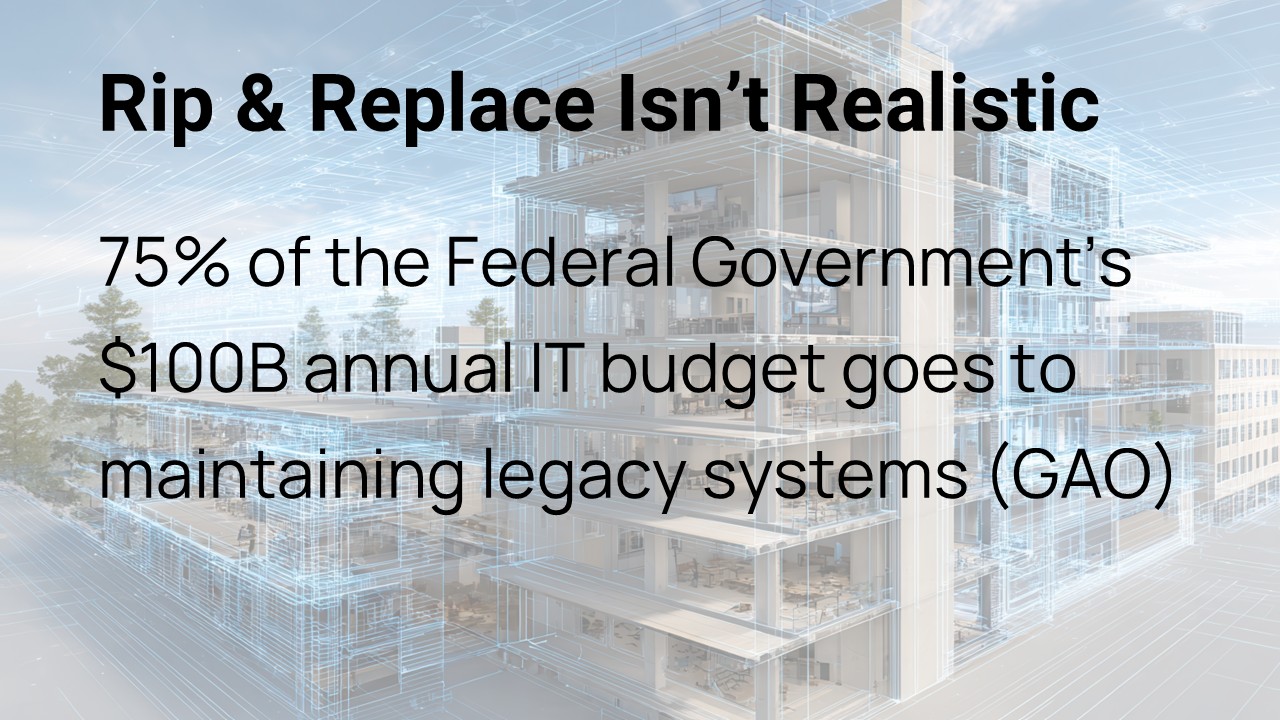
| Here’s the number that stops most modernization plans before they start: according to the U.S. Government Accountability Office, 75% of the federal government’s roughly $100 billion annual IT budget goes simply to maintaining legacy systems. Full infrastructure overhauls are increasingly hard to justify given their cost, risk, and the operational downtime they require.
The more practical path, as the webinar laid out, is targeted modernization, starting with secure communications infrastructure, and specifically with fiber. |
 |
The session included a detailed comparison of copper, fiber, and wireless transmission that’s worth summarizing:
Critically, fiber doesn’t require abandoning existing copper investments. It can be integrated at the backbone, extended into buildings and data centers, and brought out to secured zones and desktops all while working alongside the copper and PoE infrastructure already in place.
Rather than a single rip-and-replace project, the webinar described modernization as a set of moves agencies can make in whatever order fits their budget and risk tolerance:
The technology stack behind this kind of modernization typically includes network switches (fiber aggregation and edge PoE switches with fiber uplinks, rated for both commercial and hardened environments), optical transceivers and SFPs for flexibility across fiber types and data rates, media converters for fiber-to-copper and rate conversion transitions (including unidirectional converters for security-zone separation), serial-to-Ethernet devices to bridge legacy equipment, out-of-band management, and media converters or fiber network interface cards (NICs) to bring higher bandwidth and security directly to desktop PCs handling sensitive workloads.
Federal agencies have a third option between standing still and starting over. The forces driving modernization — AI, IoT growth, and evolving missions — are real and accelerating, but the budget and operational realities of federal IT make a full-scale overhaul impractical for most agencies. Fiber-based modernization, layered onto existing copper infrastructure, offers a way to meet AI-era demands for bandwidth, distance, and security incrementally, starting wherever the need is greatest.
Lantronix, which has included the Transition Networks brand since 2021 and has served government and other markets for nearly 40 years, provides a complete portfolio of fiber-to-copper media converters, optical transceivers, PoE switches, and out-of-band management solutions, all TAA- and NDAA-compliant for federal and security-sensitive environments. To learn more, visit the Lantronix Government Solutions page or connect with a reseller partner through the Lantronix Partner Locator.
Plymouth, MN; September 11, 2026 – As the United States pauses today to remember the lives lost on September 1…
Percepxion and SLC 9000 Join the NetClaw Community Network admins are actively exploring AI that targets their…
Built for how enterprise networks work today.
Lantronix Centralized Management Software