










Out-of-Band Management for how networks work today.
New products & more! See us at Cisco Live 2026, Booth 3226

New products & more! See us at Cisco Live 2026, Booth 3226
Whether you’re managing a hyperscale data center or a remote branch office, Lantronix gives you secure, autonomous access to every device — no matter what the network is doing.
Minimize downtime, cut deployment costs and sustaining continuous visibility into mission-critical infrastructure.
Power on a unit at a remote site, and it calls home over DHCP or integrated 4G/5G cellular, pulls its configuration from Percepxion, identifies every connected serial device, and appears in the fleet inventory.
All without a field technician, a staging server, or a config file transferred by hand. That removes the biggest friction point in OOB deployments: the human in the loop at installation time.
The Percepxion platform stays current without manual oversight. It continuously monitors firmware versions across the fleet, flags configuration drift, and logs every access event for audit. Its API-first architecture with OpenAI 3.0.1-compliant REST interface integrates seamlessly with your automation tools including NetBox, Ansible, Terraform, ServiceNow and custom CMDRs. When your automation tools need to interact with a device, they call the SLC9000’s full OpenAPI 3.01 REST API directly. The system responds, executes, and records the action.
No need to log into a separate management console or remember a CLI workflow. This combination of self-deploying hardware and a self-managing SaaS layer is what makes it autonomous rather than just out-of-band.
SLC 9000 + Percepxion = Out-of-band management that integrates with your tools, deploys in minutes, and keeps your infrastructure accessible.

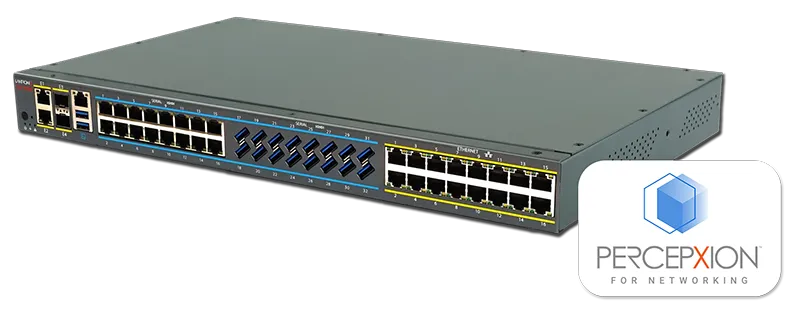
Percepxion is the management layer that turns the SLC9000 from a capable console server into a fleet-scale platform. Without it, you manage devices one at a time through a local interface, which is workable for a handful of units, but impractical across dozens of sites.
Percepxion gives the entire deployed fleet a single pane of glass: firmware compliance tracking, configuration drift detection, tamper-evident audit logs, and role-based access control with MFA through RADIUS, TACACS+, or Okta.
Because it runs as a SaaS service, there is nothing to deploy or maintain on your side. Every SLC 9000 in your fleet registers with Percepxion automatically at power-on ZTP, so the inventory is always current and accurate. For network teams managing infrastructure across many locations, that shift from per-device management to centralized, policy-driven oversight is where most of the operational value lives.

“The SLC 9000 builds on two decades of secure remote infrastructure management to address the growing scale, complexity and security requirements of modern enterprise infrastructure,”
See how the SLC 9000 and Percepxion keep your team in control — even when the network isn’t. Book your 15-minute demo today.
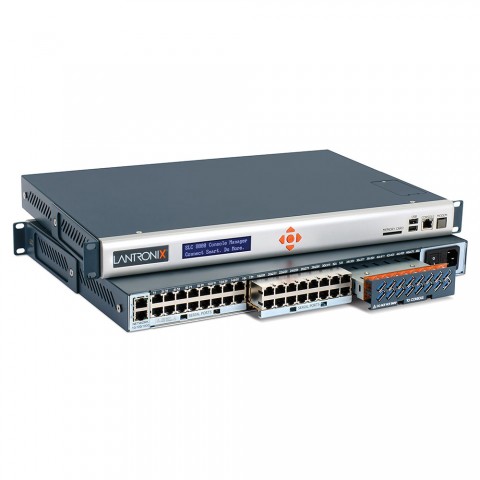
If you’re running the SLC 8000 today, you already know what reliable out-of-band management looks like. The SLC 9000 is the natural next step — not a replacement, but an evolution.

Everything your team depends on is still there: the proven console access, the authentication workflows, the reliability you’ve built your operations around. What’s new is everything that makes your job easier going forward — zero-touch provisioning, automated device discovery, and Percepxion’s cloud-native management platform that grows with your network.
At Lantronix, we don’t just build products for where networks are today. We build for where your network needs to be tomorrow. The SLC 9000 is how we get there together.
Already running the SLC 8000?

Your OOB platform keeps your network running. LEVEL keeps your OOB platform running.
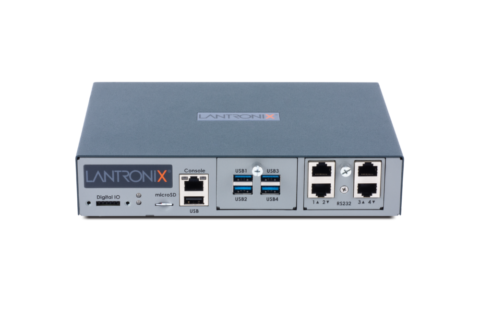
The Lantronix Autonomous Out-of-Band (AOOB) Platform is the combined solution of the SLC 9000 console server and the Percepxion™ SaaS management platform. Together, they transform traditional out-of-band management from a passive access tool into an intelligent, self-managing infrastructure layer that provisions itself on power-on, automatically discovers connected devices, and gives network administrators a single cloud dashboard to manage their entire fleet with no on-premises servers required.
When an SLC 9000 powers on, it automatically connects to Percepxion via its integrated 4G/5G cellular or DHCP with no Ethernet pre-configuration or on-site network administrator required. The device picks up its baseline policy, locks firmware to the specified version, enrolls all serial ports, fingerprints every connected device, and appears fully labeled in the fleet inventory. Based on field data, ZTP eliminates approximately two hours of on-site labor per deployment and removes the risk of a misconfigured device left unreachable in the field.
The SLC 9000 probes each serial port the moment a cable is connected (not on a scheduled scan) and captures the connected device's make, model, hostname, and software version, reporting everything to Percepxion automatically. When a cable is disconnected, the stale entry clears immediately. This means port inventory always reflects what is physically connected right now, eliminating one of the most common causes of outage delay: discovering mid-incident that port labels no longer match reality.
The SLC 9000 includes integrated 4G/5G cellular with eSIM management, providing an always-on, independent management path that stays active through any primary network failure. Cellular failover is configured centrally in Percepxion and active before it is ever needed. When an outage hits, network administrators open Percepxion, see exactly which device is unreachable, and have console access through the cellular path in seconds, with every session automatically logged to a tamper-evident audit trail.
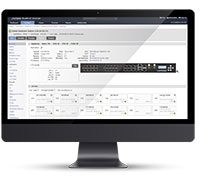
Percepxion™ is Lantronix's cloud-native SaaS management platform and the centralized control plane for all SLC 9000 deployments with no on-premises server, no database to maintain, no upgrade cycles on the management layer. From a single dashboard, network administrators get fleet-wide firmware compliance, automatic configuration backup and drift detection, real-time serial port inventory, multi-factor authentication (Azure AD, Okta, Duo, RADIUS, TACACS+, LDAP), tamper-evident audit logs, and a full REST API for integration with existing tools. Percepxion is included as a SaaS subscription with the SLC 9000.
The SLC 9000 is built with hardware-rooted security designed for Zero Trust environments: embedded TPM 2.0 and Secure Boot verify device identity from power-on, and 128 GB of encrypted eMMC storage maintains a tamper-evident log of every administrative session. Credentials are stored centrally in Percepxion rather than distributed across individual appliances which is a meaningful improvement for organizations running PAM systems like CyberArk or HashiCorp Vault. Combined with MFA, granular access controls, and an out-of-band management channel that is architecturally isolated from the production network, the SLC 9000 closes the security blind spots that unmanaged console infrastructure commonly creates.
The SLC 9000 and Percepxion expose a full OpenAPI 3.01 REST API covering every management operation including device discovery, firmware push, configuration backup and restore, audit log retrieval, and session management, all with nothing gated behind the UI. At general availability, Percepxion also ships with an MCP server, enabling AI agents and automation tools to query fleet state programmatically. The platform integrates natively with the tools network teams already run: NetBox, Ansible, Terraform, ServiceNow, and custom CMDBs which makes the out-of-band layer a fully programmable component of the broader NetOps automation stack.
Yes. The SLC 8000 reaches end-of-sale on December 31, 2026, and the SLC 9000 is the direct upgrade path. The SLC 9000 delivers the same reliable console access and authentication that SLC 8000 customers depend on, while adding Zero-Touch Provisioning, automated device discovery, integrated 4G/5G cellular, and cloud-native fleet management through Percepxion. For existing SLC 8000 deployments, the SLC 9000 is not just a hardware refresh, it is a shift from a passive console server to an autonomous management platform that reduces operational overhead at scale.
The business case for the SLC 9000 + Percepxion platform spans three areas: Zero-Touch Provisioning eliminates roughly two hours of on-site labor per site deployment; automated port inventory removes ongoing label maintenance overhead that compounds quickly at scale (a 50-unit fleet can spend $4,500/year on labels alone at standard labor rates); and accurate, always-current port data eliminates a leading cause of extended incident resolution time. One customer estimated that navigating stale OOB inventory during a live outage cost $8,000–$15,000 per incident before the root cause was even touched. Together, these make a quantifiable operational and financial case for network operations managers approving the investment.