












Remembering the Events of September 2001
Plymouth, MN; September 11, 2026 – As the United States pauses today to remember the lives lost on September 1…

Built for how enterprise networks work today.
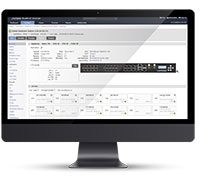
Lantronix Centralized Management Software
Buildings are getting smarter and getting smarter fast. Cameras, environmental sensors, wireless access points, lighting systems, HVAC controllers, and digital signage are multiplying across enterprise campuses, healthcare facilities, and commercial properties. With that proliferation comes an urgent operational question: is your network infrastructure actually ready for it?
Infrastructure designed five or ten years ago wasn’t built for what’s being asked of it today. The gap between legacy deployments and modern demands is widening and closing it requires more than swapping out a few switches.
What’s emerging in response is a convergence of five foundational technology pillars that together form a cohesive platform for next-generation edge infrastructure:
Modern edge networks must simultaneously deliver power, carry greater bandwidth, and surface actionable intelligence. Architectures that address only one or two of those dimensions will leave critical gaps.
PoE: Powering the Next Generation of Smart Devices
Power over Ethernet has been around for years, but its latest generation unlocks capabilities that simply weren’t possible before. At its core, PoE delivers both power and data over a single Ethernet cable thereby eliminating the need for separate electrical infrastructure at every endpoint.
The standard has evolved significantly across three generations:
|
Standard |
Max Power |
Typical Use Cases |
|
IEEE 802.3af |
15W |
IP phones, basic cameras |
|
PoE+ (802.3at) |
30W |
PTZ cameras, wireless access points |
|
PoE++ (802.3bt) |
60–90W |
LED lighting, digital signage, thin clients |
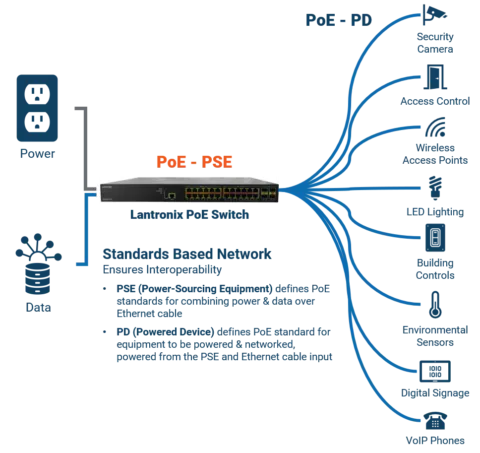
That top-end PoE++ capability is particularly significant for intelligent LED lighting. PoE-powered luminaires enable per-fixture dimming, occupancy-based automation, and real-time energy metering. The reported energy reductions of 50 to 70 percent across deployments, which for large commercial buildings, that’s a material impact on operating costs.
Beyond lighting, PoE serves as the connectivity backbone for smart building IoT: access control, environmental sensors, digital signage, and industrial devices. Because all endpoints are powered through the switch, remote power cycling is straightforward which dramatically simplifies day-to-day operations. When PoE switches are backed by UPS or generator power, every connected device stays online during a grid outage, keeping security systems and building automation running continuously.
Fiber: The Foundation of Future-Ready Networks
Copper has served enterprise networking well, but it carries inherent constraints including a 100-meter distance limit and a hard bandwidth ceiling. As buildings scale and workloads intensify, those constraints become real bottlenecks.
Fiber eliminates them. It supports 10GbE and 25GbE connections, spans distances measured in kilometers rather than meters and is completely immune to electromagnetic interference. This is a significant advantage in environments with heavy industrial equipment or dense RF activity.
Two fiber benefits that often go underappreciated are security and sustainability. Unlike copper, fiber doesn’t radiate electromagnetic signals, which matters for government, finance, and healthcare environments where signal leakage is a compliance concern. Physical tampering is also immediately detectable as a measurable drop in light transmission. On the sustainability side, fiber’s dramatically longer lifecycle means bandwidth upgrades happen at the transceiver, not the cable which fundamentally changes the economics of infrastructure refresh cycles.
Fiber-to-the-Desk takes these advantages all the way to the endpoint with secure, high-bandwidth, interference-free connectivity at the workstation level, ideal for secure facilities, dense office environments, and air-gapped network requirements.
Serial-to-Ethernet: Bridging Legacy into Modern IP Networks
Look inside any industrial facility, hospital, or older commercial building, and you’ll find serial interfaces everywhere: RS-232, RS-485, RS-422 from PLCs, HVAC controllers, point-of-sale systems, access control panels, medical devices, console ports. These devices represent significant capital investment and are often deeply embedded in operations.
Serial device servers solve the integration challenge through transparent protocol conversion where the serial device believes it’s communicating with another serial device, while the network sees standard TCP/IP traffic. The integration is seamless, and the existing equipment stays in service.

Serial interfaces persist for good reason: they’re deterministic, simple, and purpose-built, with no IP configuration to manage, no DHCP dependency, and have minimal firmware attack surface. That simplicity is a feature in machine-interface contexts. Serial device servers modernize that infrastructure without replacing it, extending its useful life while enabling centralized remote access, logging, and monitoring across every connected device.
Out-of-Band Management: Network Resilience When It Matters Most
Every network team has experienced some version of this scenario: a critical device becomes unreachable. You attempt to log in and diagnose the problem but the management path runs over the same network that just failed. You’re locked out of the tools you need to fix the outage.
This is the fundamental circular dependency of in-band management. Out-of-Band Management (OOB) breaks that dependency by establishing a dedicated management plane that is physically separate from the production network . Typically the connection is via an independent cellular LTE or 5G path. When the primary network fails, management access remains available regardless of what’s happening on the production side.
The operational impact is measurable. Without OOB, an outage typically requires a field dispatch meaning response times measured in hours. With OOB, remote and often autonomous diagnosis and remediation bring that down to minutes. For multi-site organizations in retail, healthcare, or financial services, the ROI is compelling because the cost of a single prevented field dispatch can justify the investment across an entire site.
Edge AI: Intelligence Where Data Is Born
The traditional model sends data to the cloud for processing. As data volumes have grown, the problems with that model have become harder to ignore including cloud latency, WAN bandwidth consumption, cloud dependency risk, and maybe most critically, sensitive operational data leaving the organizational perimeter.
Edge AI inverts this model. Intelligence runs at the point where data is generated, eliminating those constraints entirely. In practice, that looks like:
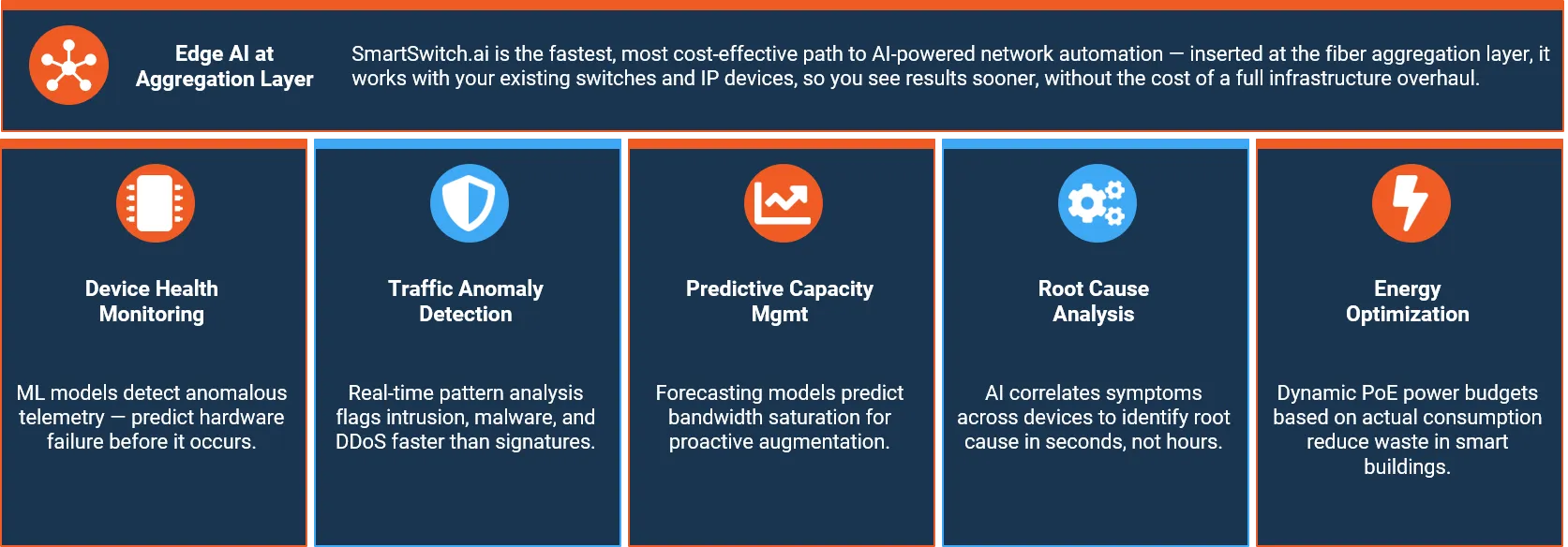
The optimal insertion point for edge AI is the fiber aggregation layer. By embedding intelligence at aggregation, organizations gain visibility across their entire existing switching and IP device infrastructure without replacing cameras, sensors, or access points with purpose-built AI hardware. That means time-to-value measured in weeks, not years.
A Practical Path Forward: Three Phases
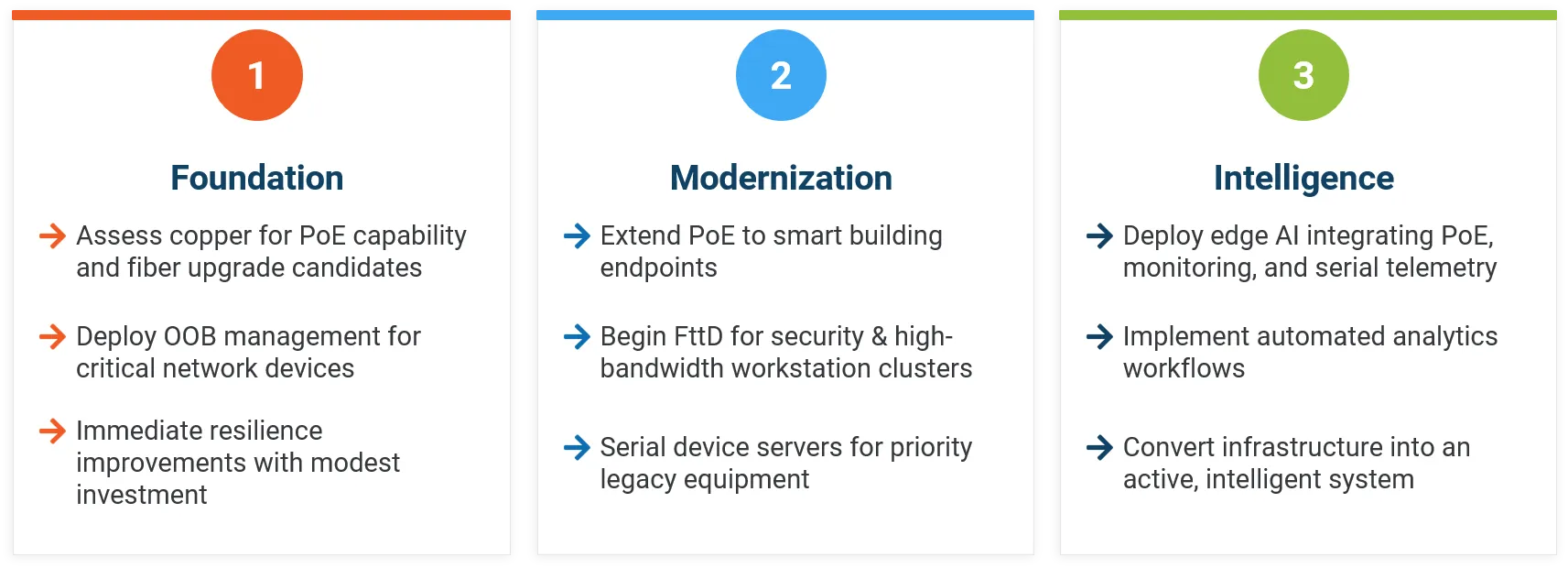
Moving from where most organizations are today to a fully intelligent edge network doesn’t require a rip-and-replace approach. A phased rollout lets teams build incrementally while delivering value at each stage.
Phase 1 – Foundation
Assess existing copper for PoE capability, identify fiber upgrade candidates, and deploy Out-of-Band management for critical devices. This delivers immediate resilience improvements with modest investment and is where most organizations can start today.
Phase 2 – Modernization
Extend PoE to smart building endpoints, roll out Fiber-to-the-Desk for security systems and high-bandwidth workstations, and deploy serial device servers for priority legacy equipment. This phase expands capability and builds the data foundation that edge AI will use.
Phase 3 – Intelligence
Deploy edge AI integrated across PoE infrastructure, network monitoring, and serial device telemetry. At this stage, infrastructure transitions from a passive transport layer to an active, self-monitoring system that predicts problems and automates responses.
Each phase is sequential by design: each one builds the data foundation the next relies on. But they can be paced to match budget cycles and operational priorities, making the investment manageable even for organizations with constrained capex.
Ready to Get Started?
Whether you’re a reseller partner or evaluating edge infrastructure for your own organization, Lantronix offers a complete, integrated solution stack spanning PoE switching, fiber, serial device servers, Out-of-Band management, and edge AI — all managed through a single platform.
Plymouth, MN; September 11, 2026 – As the United States pauses today to remember the lives lost on September 1…
Percepxion and SLC 9000 Join the NetClaw Community Network admins are actively exploring AI that targets their…
Built for how enterprise networks work today.
Lantronix Centralized Management Software