














LMOS 6.8: Practical Updates for Enterprise Out-of-Band Management
Lantronix LMOS 6.8 is now available for the LM-Series Console Servers and Lantronix Control Center. This relea…

Built for how enterprise networks work today.
Lantronix Centralized Management Software


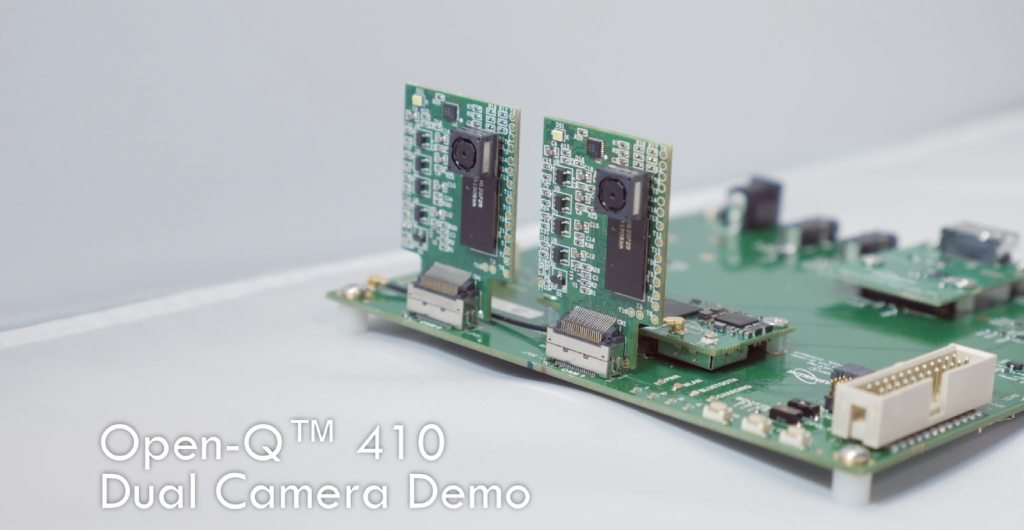
Two cameras are critical for products such as robotics with stereo vision (two angles of the same view enabling depth and shape detection), and 360 degree views in IoT security cameras. The big challenge with connecting two cameras to the SnapDragon™ 410, is that the 410 contains a single Image Signal Processor (ISP). This blog unveils Intrinsyc’s Open-Q 410 supporting simultaneous dual camera capture, even though there is a single ISP on the 410 processor.
The Snapdragon™ System-on-Chip that powers the Open-Q™ 410 development kit is quite amazing: From the processor specifications available here, you can see it has very compelling capabilities, including quad-core 64-bit ARM Cortex A53 CPUs, onboard GPU, and many additional capabilities.
Intrinsyc’s Open‐Q™ 410 Embedded Development Kit is a versatile, easy‐to‐use exposed board platform providing the ideal starting point for creating the next generation embedded and IoT devices. The platform consists of Intrinsyc’s Open‐Q™ 410 System on Module, a carrier board exposing all the available IO, and a range of accessories to fast track your product development. The Open-Q™ 410 System on Module (SOM) is especially suited for mobile and IoT applications, having:
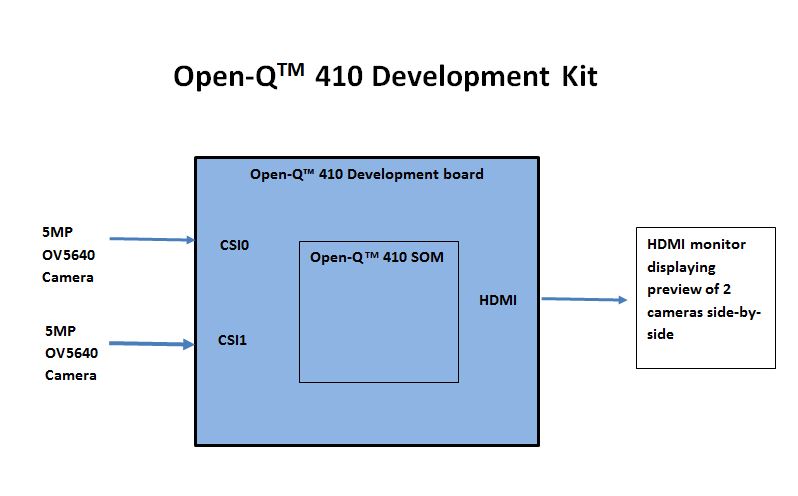
One very powerful subsystem includes the ISP capable of supporting up to 13MP cameras. Intrinsyc’s Open-Q 410 development kit brings out two MIPI-CSI camera ports allowing you to connect two cameras to the platform, which some products support by using the ISP in an alternating fashion. Dual camera products such as industrial robotics with stereo images which must be synchronized for accurate image processing, or stereoscopic drones with terrain mapping, however, are greatly improved by using MIPI-CSI connected cameras concurrently. In this blog, we demonstrate the use of both Open-Q™ 410 MIPI-CSI camera ports concurrently: one via the ISP and one via the Raw Data Interface (RDI) path, allowing simultaneous dual camera operation. This capability allows for many possibilities to process the two resulting images in RAM. As examples:
The following diagram represents the configuration in this demonstration:
The following link is a video that demonstrates this feature in operation:
https://www.youtube.com/watch?v=hF6PVW9CbQ8
The demonstration shows the Intrinsyc Open-Q™ 410 dev kit running Android 5.1.1 with 2 concurrent cameras operating and previewing video:
This demonstration showcases the use of two cameras simultaneously on the Open-Q™ 410 SOM. This challenging operation is possible despite the presence of a single image signal processor (ISP) on board the Snapdragon™ 410 processor. Additional resolutions/framerates are available.
Lantronix LMOS 6.8 is now available for the LM-Series Console Servers and Lantronix Control Center. This relea…
Reconciling network management strategies with business needs involves balancing uptime service level requirem…
Built for how enterprise networks work today.
Lantronix Centralized Management Software