Open Menu

Out-of-Band Management

AI-Driven Automation and Console Access for Enterprise Networks

Software

Lantronix Centralized Management Software

Services

Resources

From training , to white papers, videos, and more, you’ll find what you need to design, develop, deploy and manage powerful, innovative remote networking and IT infrastructure management applications and solutions.

Support

Visit the Technical Resource Center for all of your support needs

Fiber to the Desk Solutions

The amount of data created every day is astounding and is estimated to reach 175-180 Zettabytes in 2025, depending on the source. Most people have never even heard of a Zettabyte, but one zettabyte is equal to a trillion gigabytes. Whatever the exact number, it is clear that data is growing at an enormous rate.

Some of the industries experiencing the fastest rate of data growth include manufacturing, financial services, media and entertainment and healthcare. Government, education and other sectors are also high users of data. In fact, it is hard to find a company or organization that doesn’t rely heavily on fast and reliable access to or transfer of data.

Moving all that data requires robust networks to support it. Traditional twisted pair copper cabling has served us well for many decades, but it does have shortcomings, particular as transmission speed and distance increases. Wireless networks are increasingly more common, but wireless service can still be unreliable in some locations and is not allowed in certain organizations. Fiber optic networks can overcome some of these challenges, but it is not always feasible or cost-effective to replace the entire copper infrastructure.

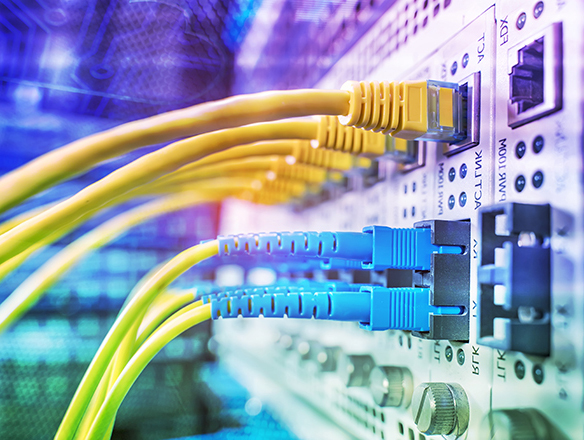
As the name implies, Fiber to the Desk (FTTD) is the application of integrating fiber optic cabling with existing copper infrastructure. Many buildings already have fiber cabling within building risers, and extending those fiber links to computers, laptops, tablets, thin clients, and IP phones at the desktop can offer multiple benefits in terms of network speed, efficiency and security.

Here’s a quick look at some of the reasons organizations should consider integrating fiber to desktop applications:

  • Improved Security: Fiber cable reduces the risk of data leakage and disruptions because it is shielded from electromagnetic interference (EMI) and radio frequency interference (RFI). Copper cabling, on the other hand, emits electromagnetic signals that can create interference and enable hackers to access unprotected data.
  • Higher Throughput: Fiber has a higher data throughput capacity than copper, allowing faster network speeds.
  • Increased Bandwidth/Reliability: The flexible capacity of fiber cable means that bandwidth and reliability are guaranteed, even as demand for data sharing grows. Wireless networks, on the other hand, can be negatively impacted by increased number of users and amount of traffic from bandwidth-hungry applications.
  • Affordability: While the costs to manufacture and install fiber cabling used to be significantly higher, these costs continue to decrease as usage of fiber continues to rise. In addition, ongoing maintenance costs for fiber networks are much lower than for copper.
  • Future Proofing: Installation of fiber cabling helps ensure that communication networks will keep pace with network traffic growth. It also provides support for higher data rates and future network applications.

Lantronix FTTD solutions include a wide variety of Network Interface Cards (NICs) and media converters that can be implemented at the desktop point of transition from fiber to copper. Lantronix fiber Ethernet NICs provide a fiber connection to PCs, thin clients, micros and laptops and follow industry standards, such as PCIe, M.2 and USB, to ensure compatibility and reliability. Lantronix copper to fiber media converters provide the connection point for copper and fiber cabling and are compact, cost-effective solutions that can be easily placed on or under a desk top or discreetly mounted to the back of a monitor. The ideal FTTD solution depends on your network and what devices are being connected. 

Some characteristics of environments where FTTD is optimal for deployment include:

  • High security networks
  • Virtual networks using thin clients
  • LAN networks with extended distance to workstations
  • Locations where power is limited or unavailable (Power over Ethernet options available)
  • Businesses enhancing bandwidth availability
  • Operations moving video or data at high transmission rates

Fiber to the Desk

Out-of-Band Management

AI-Driven Automation and Console Access for Enterprise Networks

Software

Lantronix Centralized Management Software

Services

Resources

From training , to white papers, videos, and more, you’ll find what you need to design, develop, deploy and manage powerful, innovative remote networking and IT infrastructure management applications and solutions.

Support

Visit the Technical Resource Center for all of your support needs

By continuing to use the site, you agree to the use of cookies. more information

The cookie settings on this website are set to "allow cookies" to give you the best browsing experience possible. If you continue to use this website without changing your cookie settings or you click "Accept" below then you are consenting to this.

Close