













The Network Edge is Now the Front Line. Is Your Management Plane Ready?
Attackers are no longer waiting at the firewall. They are already inside edge devices, moving fast, and covering their tracks before most security tools even notice.
The recent CrowdStrike 2026 Global Threat Report makes this clear. The average time for an attacker to move laterally after gaining a foothold has dropped to just 29 minutes. The fastest recorded case: 27 seconds. In some attacks, data exfiltration began within four minutes of initial access. These are not speeds that human-operated response processes can match.
For network administrators, this shift changes what resilience means. It is not just about stopping attacks at the perimeter; it’s about maintaining control of your infrastructure when an attack is already underway and recovering fast when it is not stopped in time.
Out-of-band management has become a critical part of that answer. Here is why.
Attackers Are Targeting the Devices You Manage
The 2026 report documents a sharp focus on network edge infrastructure by state-sponsored actors. China-nexus groups used internet-facing edge devices as their initial access vector in 40% of exploited vulnerabilities, targeting VPN appliances, firewalls, and gateways. These devices are selected for a reason: they often run with minimal endpoint detection coverage, inconsistent patch cycles, and reduced logging.
One adversary group, identified in the report as OPERATOR PANDA, modified TACACS+ configurations on compromised devices to redirect traffic to attacker-controlled infrastructure. That is not a malware infection. That is a configuration change, made through the same management plane your team uses every day.
Another group exploited unmanaged devices as staging grounds. In one case, attackers executed ransomware directly from an unpatched webcam on the corporate network. The webcam had no detection tools. It was simply there, reachable, and ignored.
These incidents share a common thread: the attacker got into infrastructure that was not being actively managed, monitored, or protected with the same rigor as endpoints.
The 72-Hour Patching Window Is Not Optional
When a critical vulnerability is disclosed on a network edge device, the CrowdStrike report finds that adversaries consistently weaponize it within two to six days. The report’s recommendation is direct: patch internet-facing appliances and edge devices within 72 hours of a critical disclosure.
That is a tight window for any team managing routers, switches, and firewalls across distributed sites. Doing it manually means coordinating access, staging configs, hoping nothing goes wrong mid-update, and having a recovery plan if it does.
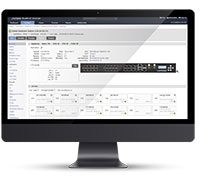
The Lantronix LM-Series makes mass OS updates a scheduled, automated operation. Administrators can define an OS Policy for specific device makes and models in Lantronix Control Center. The system then applies those images across the network using advanced filtering: by location, device group, make, model, and OS version. If a device is replaced due to RMA, the LM automatically loads the last known good configuration and the defined standard OS image. No manual staging. No gaps.
The LM-Series stores multiple OS images and 20 running configurations locally for each managed device, so the files needed for a rapid update or recovery are always on hand, at the edge, independent of the production network.
Configuration Changes Cause Outages. Automated Rollback Stops Them.
The CrowdStrike report highlights that OPERATOR PANDA’s technique was a configuration modification. That is the same category of change that causes 27% of network outages in normal operations.
Most of the time, it’s non-malicious: an administrator pushes an ACL update to a remote router. The terminal goes silent. They have locked themselves out.
Without out-of-band management, someone has to go to the site. With the Lantronix LM-Series, the situation resolves automatically in minutes.
When an administrator accesses a device through Control Center, the LM saves the current running configuration locally before any changes are made. If the session drops, an inactivity timer starts. When it expires, the LM automatically backs out the previous change and restores the last working configuration. Access is restored, typically before anyone outside the immediate team knows there was a problem.
The system keeps 20 saved configurations per device, and all changes are logged. Every keystroke typed during a terminal session is recorded and stored both locally and in Control Center, giving compliance teams a full audit trail of who changed what and when.
Your OOB Link Is Your Lifeline During an Attack
Security experts, and also government agencies including CISA and the NSA, recommend separating management traffic from production traffic. The LM-Series is built around that principle.
When a DDoS attack, ransomware deployment, or state-sponsored intrusion compromises the in-band network, most management tools go dark. The LM-Series does not. It connects to managed devices over a dedicated path (the console or management port), and can use cellular, dial-up, or fiber as a secondary access channel that is independent of the production network.
From that secure channel, administrators can take action at scale. The LM’s rules-based automation can execute mass configuration changes across thousands of routers, switches, and firewalls simultaneously: updating ACLs, isolating segments, or cycling power on specific devices, all from a single scheduled batch job in the Lantronix Control Center.
With continuous monitoring of managed devices, the LM-Series even detects issues like a router dropping into ROMmon mode by watching for the expected hostname prompt on the serial console. If the prompt is missing, the LM automatically restarts the device, breaks into the boot cycle, acts as a TFTP server, and reloads the saved OS image and configuration. The router comes back online, often before centralized monitoring tools have registered the failure.
During any of this, the LM continues forwarding alarms, events, and SYSLOG messages through the out-of-band link, keeping security teams informed in real time even if the primary network is down.
Visibility That Does Not Tax the Network
Traditional SNMP-based monitoring tools poll devices every 15 minutes or more, partly because more frequent polling strains both the production network and the managed devices themselves.
The LM-Series monitors every connected device over the serial console connection by default every 30 seconds. That connection does not touch the production network, so there is no performance cost. The LM parses the data locally, watching for CPU spikes, interface drops, log patterns, and other indicators of problems.
When the data matches a condition defined in the rules engine (including trends over time), the LM acts. It can clear an interface, initiate an out-of-band connection, cycle power, or run a CLI command, all without waiting for a human to notice an alert. The response follows the steps you would have taken yourself, your runbook executed automatically every time the condition appears.
For server infrastructure running NFV or SD-WAN workloads, the LM connects to the server’s baseboard management controller over Ethernet or serial, or both. Through the IPMI connection, administrators can remotely monitor, diagnose, and recover servers even when the operating system has crashed. Kernel logs, CPU and memory statistics, environmental data, and power controls are all accessible through the same out-of-band path.
What the 2026 Threat Landscape Requires
The CrowdStrike 2026 report lays out a direct mandate for network teams: move faster than attackers, eliminate unmanaged blind spots, and maintain a secure, independent management path for all infrastructure.
The Lantronix LM-Series is built for exactly that. It puts continuous monitoring, automated recovery, mass configuration management, and a secure out-of-band channel directly in the rack, alongside every device it manages.
When your in-band network is under attack, your management plane needs to be somewhere else entirely. With the LM-Series, it is.
To learn more about the Lantronix LM-Series and out-of-band management for enterprise networks, visit lantronix.com/oobm.
Related Posts

March 24, 2026 Industry Trends
The Network Edge is Now the Front Line. Is Your Management Plane Ready?
Attackers are no longer waiting at the firewall. They are already inside edge devices, moving fast, and coveri…

February 25, 2026 Industry Trends
Closing the Network Automation Trust Gap: A Strategic Framework for Enterprise Resilience
In the modern enterprise, a significant disparity exists between the automation maturity of server infrastruct…