










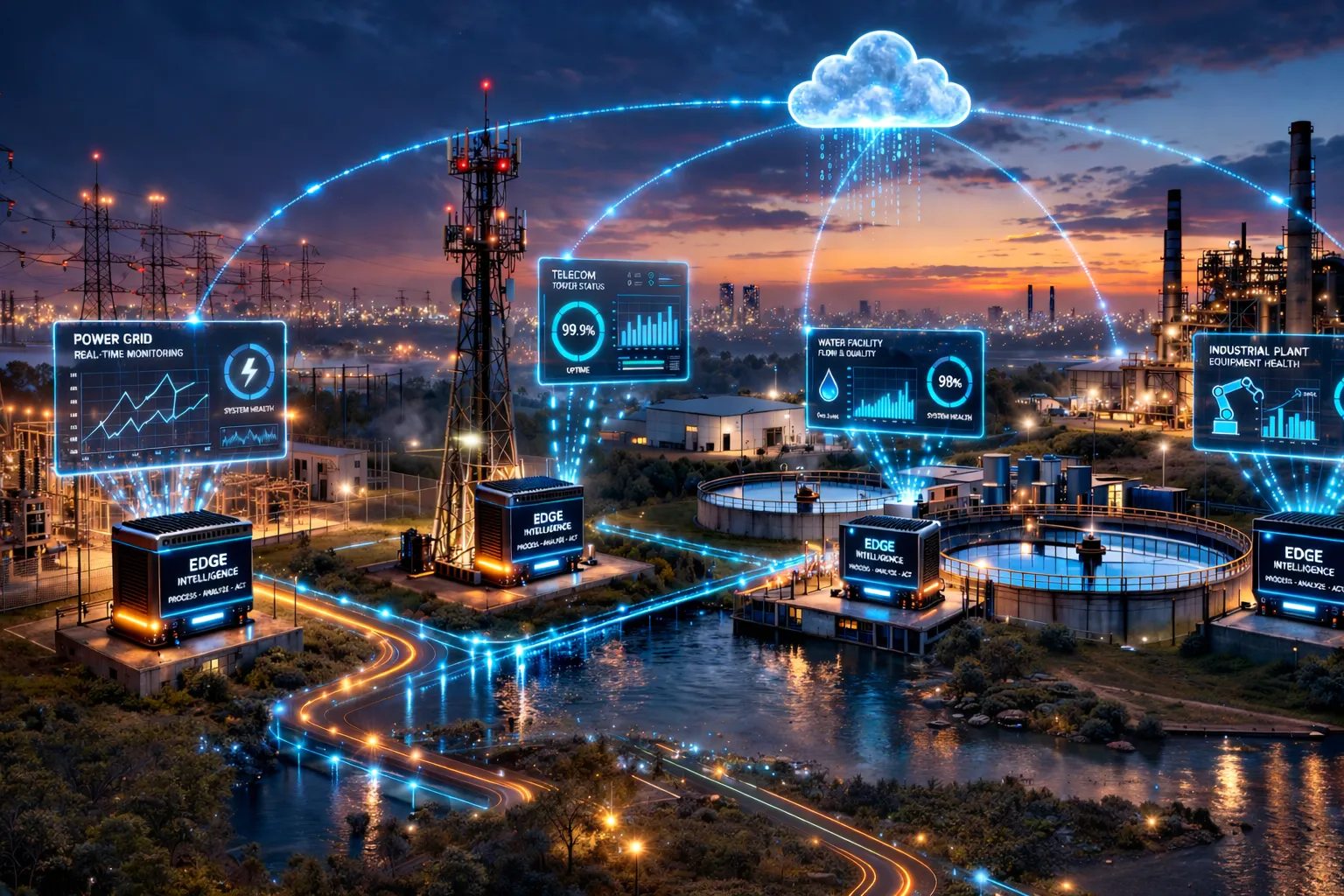
Critical Infrastructure Is at a Tipping Point — Digitizing Distributed Assets at Scale
Across the world, critical infrastructure systems — including energy grids, water networks, telecom towers, transportation systems, and industrial equipment — are under increasing operational pressure. These systems have supported modern society for decades, but the way they are managed is rapidly changing. In many industries, unplanned outages can cost thousands of dollars per hour, making downtime far more expensive than in the past. At the same time, assets are producing massive streams of operational data such as vibration, temperature, pressure, voltage, and cycle time signals. Traditional monitoring systems were never designed to manage this level of complexity or scale.
Why Monitoring Can’t Stay the Same
Historically, infrastructure monitoring relied on periodic inspections, legacy SCADA platforms, and reactive maintenance processes. A technician would visit a site, inspect equipment, log readings, and move on to the next location. This approach worked when assets were fewer and more centralized.
Today, however, operations are far more distributed. Organizations now manage hundreds or even thousands of remote assets including substations, pump stations, manufacturing lines, cell towers, compressors, and mobile generators. At the same time, workforce shortages and rising maintenance costs are placing additional strain on operations. Cybersecurity risks are also escalating as operational technology environments become more connected.
Together, these factors make traditional centralized monitoring models difficult to sustain.
Industry Insight: The Shift from Monitoring to Intelligence
The challenge facing operators is not simply collecting more data. The real requirement is making data actionable at the exact location where the asset operates. Organizations increasingly recognize that sending all operational data to centralized cloud platforms introduces cost, latency, and security challenges.
As a result, infrastructure operators are shifting toward architectures that process and analyze data closer to the asset itself, allowing insights to be generated locally before events escalate into failures.
Technology Approach: Why Edge Intelligence Is Becoming the New Standard
Edge monitoring and edge computing transform the traditional model by placing processing capabilities directly at the infrastructure site. This architecture enables several operational advantages:
- Real-time operational awareness without depending on constant cloud connectivity
- Lower operating costs by reducing bandwidth, storage, and compute usage
- Improved security, as sensitive operational technology data remains within a controlled environment
Importantly, modernization does not require replacing existing equipment. Many industrial systems still rely on technologies such as PLCs and fieldbus protocols like Modbus, CAN, and BACnet. Modern edge platforms can communicate with these legacy technologies, allowing decades-old equipment to become digitally connected without costly infrastructure replacements.
Related Deployment Approach
Lantronix addresses the challenges of distributed infrastructure through an integrated architecture built around edge intelligence and centralized orchestration.
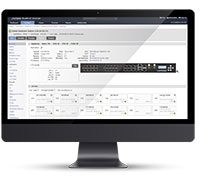
The FOX Edge Intelligence Platform processes and analyzes operational data directly at the asset, enabling real-time alerts and reducing reliance on cloud connectivity. It can read and normalize industrial protocols from legacy equipment while filtering and transmitting only meaningful event data.
Complementing this capability, Percepxion™ provides centralized visibility and management across large device fleets. It enables secure remote monitoring, automated provisioning, and scalable deployment management for thousands of distributed devices.
Together, these platforms allow organizations to modernize infrastructure operations without replacing existing equipment.
The management of critical infrastructure is undergoing a fundamental transformation. Traditional monitoring methods that depend on centralized systems and manual inspections are no longer sufficient for the scale and complexity of modern operations.
Edge intelligence technologies enable organizations to process operational data directly where assets operate, improving responsiveness, reducing costs, and strengthening security. Platforms such as the FOX Edge Intelligence Platform, Percepxion fleet management, and the SmartEDGE 5G Edge AI Gateway represent the next phase of infrastructure modernization by enabling distributed intelligence, centralized control, and scalable automation.
As infrastructure continues to digitize, organizations that adopt edge intelligence and AI-enabled platforms will be better positioned to maintain uptime, improve efficiency, and manage increasingly complex distributed environments.
Related Posts

March 24, 2026 Industry Trends
The Network Edge is Now the Front Line. Is Your Management Plane Ready?
Attackers are no longer waiting at the firewall. They are already inside edge devices, moving fast, and coveri…

February 17, 2026 General
The Hidden Cost of Network Complexity — and How PoE Is Powering Intelligent, Sustainable Environments
As digital infrastructure expands across smart buildings and smart cities, organizations are facing rising cos…