













Closing the Network Automation Trust Gap: A Strategic Framework for Enterprise Resilience
In the modern enterprise, a significant disparity exists between the automation maturity of server infrastructure and the networking domain. While DevOps teams have long utilized infrastructure-as-code to manage thousands of containers, network engineers often remain hesitant to adopt similar practices. This stagnation is not due to a lack of technical capability or available tools like Ansible and Python; rather, it is the result of a Trust Gap.
The reality of the Trust Gap
The Trust Gap is driven by the potential blast radius of a single configuration error. In networking, the control and data planes are frequently intertwined; a flawed automated script can inadvertently disable secondary systems like security cameras, badge readers, and, most critically, the connection required to fix the error. This risk of total lockout often leads to a persistent risk aversion stemming from past outages caused by human or automated errors.Transitioning to automated out-of-band solutions
To bridge this gap, organizations must move beyond traditional, passive out-of-band management. Historically, console servers were utilized as reactive, “break-glass” tools that relied on human intervention via a modem or cellular link. Automated out-of-band solutions represent a paradigm shift by moving intelligence to the network edge.Platforms, such as the Lantronix LM-Series, function as an independent resilience layer. These devices possess local CPU, memory, and management software, allowing them to participate actively in network operations. Because they are physically connected to the console ports of primary infrastructure with functional logins, they can rapidly detect failures and execute recovery playbooks locally without requiring instructions from a central cloud controller or a functioning WAN link.
The role of automated out-of-band in the Network Automation Forum (NAF) framework
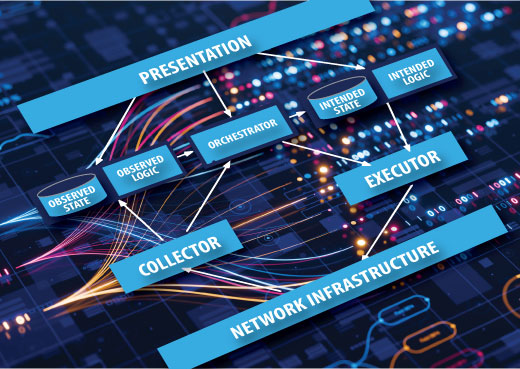 The Network Automation Forum (NAF) published an automation framework. Within the NAF architectural model the LM-Series fulfills two critical functions:
- Distributed Collector | Unlike in-band tools that fail when the network stack crashes, an LM-Series device captures “dying gasp” data directly from the serial stream. This includes kernel panics and segmentation faults that occur before an SNMP trap or Syslog message can be transmitted, providing essential data for root cause analysis.
- Executor of Last Resort | When primary management paths via SSH are unavailable, the LM platform serves as the secondary execution environment. It interacts directly with the Command Line Interface (CLI) to restore connectivity or revert changes.
Operational value across the lifecycle
Implementing a resilience layer provides measurable ROI from initial deployment through ongoing maintenance:
- Day 0 (Provisioning) | Integrated 5G/LTE connectivity allows for Zero Touch Provisioning (ZTP). The LM-Series and managed devices can be configured and verified via console before an ISP delivers the primary circuit, decoupling infrastructure readiness from local provider timelines.
- Day 1 (Configuration Deployment) | The LM-Series allows for safer configuration changes. If a device fails to reach the central controller within a defined window after a change, the LM can automatically issue a rollback command via the console port.
- Day 2 (Remediation) | The platform can automatically detect and resolve boot loops during firmware updates. By monitoring console logs, it can interrupt failing boot sequences and direct the hardware to boot from a backup partition, preventing the need for on-site technician visits.
Conclusion
True network automation is only as reliable as its recovery mechanism. By deploying an autonomous out-of-band resilience layer, enterprise IT leaders can provide their teams with the necessary safeguards to increase automation velocity while maintaining high availability. The Lantronix LM-Series serves as the fundamental control plane that ensures network continuity, regardless of the primary network’s status.
Related Posts

February 25, 2026 Industry Trends
Closing the Network Automation Trust Gap: A Strategic Framework for Enterprise Resilience
In the modern enterprise, a significant disparity exists between the automation maturity of server infrastruct…

January 28, 2026 Technical Articles
LMOS 6.8: Practical Updates for Enterprise Out-of-Band Management
Lantronix LMOS 6.8 is now available for the LM-Series Console Servers and Lantronix Control Center. This relea…